impurity doping
The process of varying the electrical boundary conditions by introducing atoms of foreign elements into the crystal structure.
Impurity classes
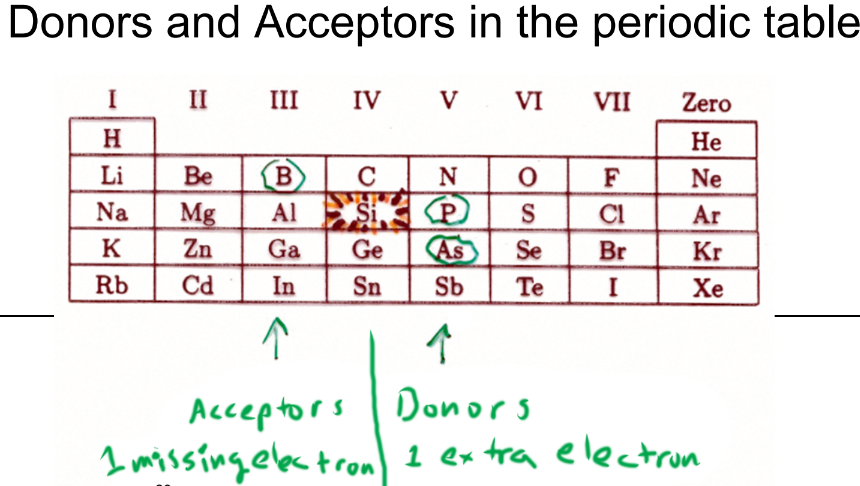
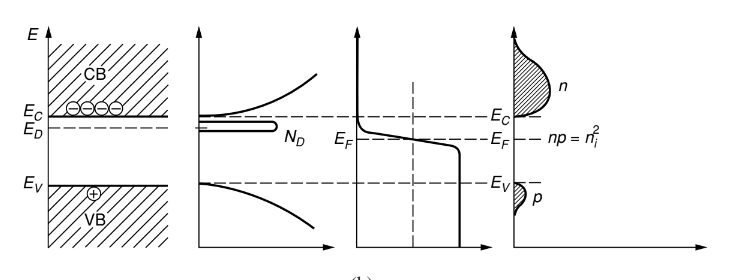
Donor impurity: It is an atom with a valence electron more than the semiconductor. Since the additional electron does not fit into the crystal structure it is loosely bound (mobile) to it's nucleus (donors form an energy level in the bandgap that is close to the conduction band edge).
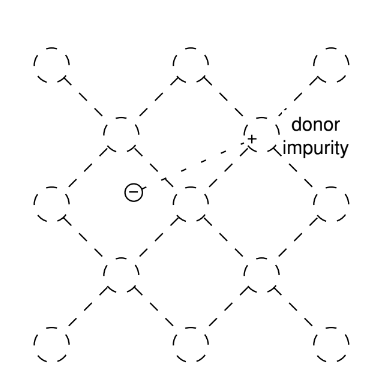
Introduction of donors moves the fermi level from the center of the band gap to the conduction band edge. If the donor density is higher than the acceptor density there will be more electrons in the conduction band than holes in the valence band ($n>p$), the semi-conductor is said to be n-type. (The majorority of carriers are electrons)
ATOMS:
- $P$
- $As$
Acceptor impurity: It is an atom with a valence electron less than the semiconductor. Acceptors have loosely bound holes close to the valence band edge.
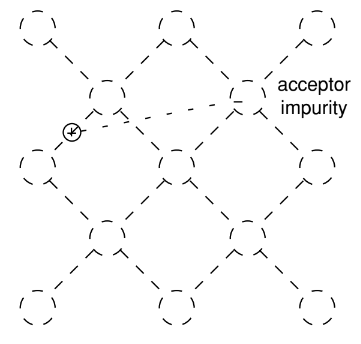
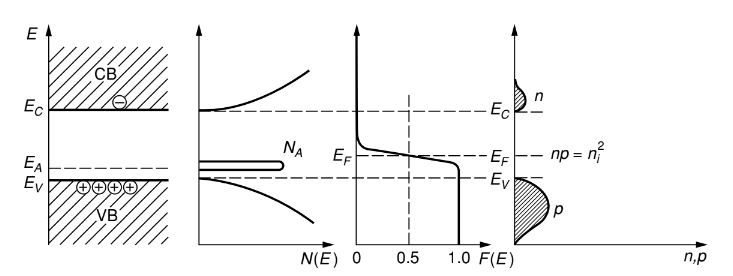
Introduction of acceptors moves the fermi level from the center of the band gap to the valence band edge. If the donor density is smaller than the acceptor density there will be less electrons in the conduction band than holes in the valence band ($n<p$), the semi-conductor is said to be p-type. (The majority of carriers are holes)
ATOMS:
- $B$
Notes:
- The impurity atoms are always electrically neutral (protons=electrons).
- Most donors and acceptors are thermally ionized ar room temperature.
- The ionization energy of an impurity atom is on the order of $0.05 eV$.
Band diagrams
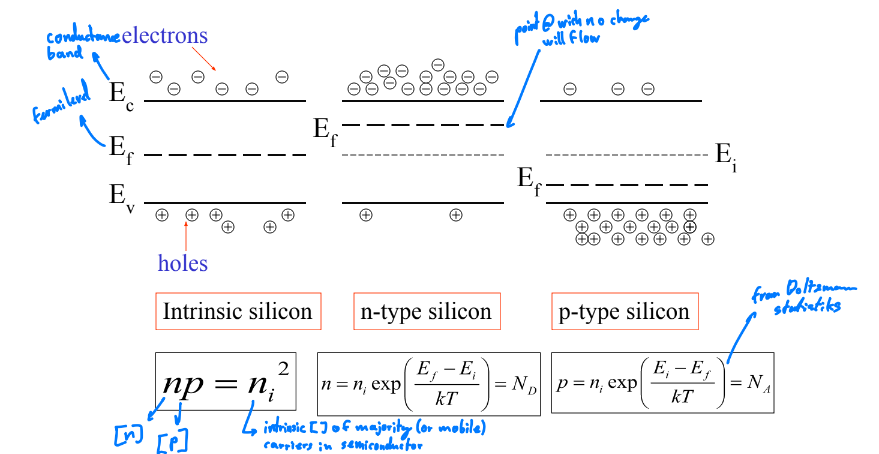
$N_{A}$ denotes the acceptor impurity concentration and $N_{D}$ denotes the donor impurity concentration. We have:
$n+N_{A}=p+N_{D}$
For n-type:
For p-type: