Early effect
Above threshold saturation
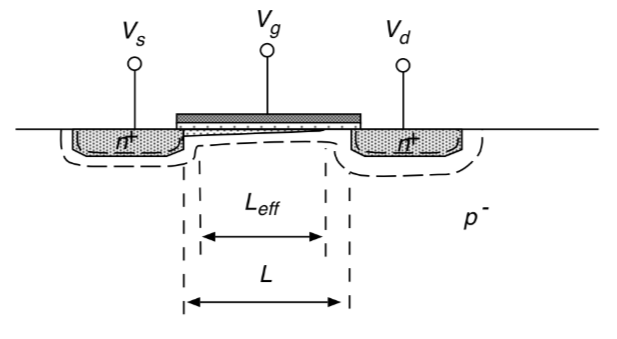
When deriving the I–V characteristics of the nFET we assumed that the current is constant in the saturation regime. This assumption is not sufficient, particularly for short-length MOSFETs. The drain voltage can modulate the channel current even in saturation. In the above-threshold saturation regime, the effective length of the transistor,$L_{eff}$ , decreases when $V_{d}$ increases because the pinchoff region extends further along the channel away from the drain. We describe as the difference between the drawn channel length,$L_{eff}$ , and the size of the pinchoff region. Hence, the transistor current increases with $V_{d}$.
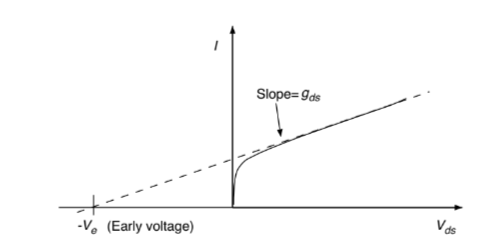
The Early voltage is defined as the absolute value of the voltage at which the slope intersects the voltage axis on this curve.
Formula:
$V_{e}=-L_{eff} \frac{\delta V_{ds}}{\delta L_{eff}}$.
$Ve$ is named after Jim Early who first analyzed this effect in BJTs.
Subthreshold
This effect also occurs in subthreshold (because of the finite slope of the I-V curve)
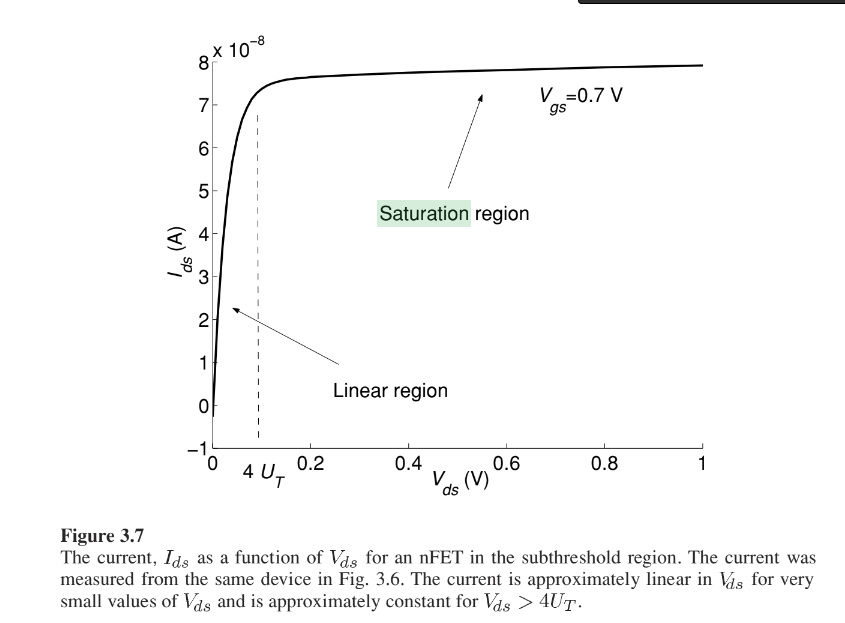
In the subthreshold domain, the saturation current,$I_{sat}$ , which is given by:
$I=I_{sat}+g_{ds}V_{ds}=I_{sat}\left( 1+ \frac{V_{ds}}{V_{e}} \right)$
accounting for the early effect.
Realtion to conductance
$g_{ds} = \frac{I}{V_{e}}$