WTA
Network overview
A winner takes all circuit is a network of competing cells that reports only the response of the cell that has the strongest activation and supresses the response of all the other cells. It essentially implements a $max()$ function. Here we consider a cluster of excitatory neurons that innervate a global feedback inhibitory neuron (Fig.6.5). Implementations: selective attention, visual stereopsis, tracking and head direction detection.
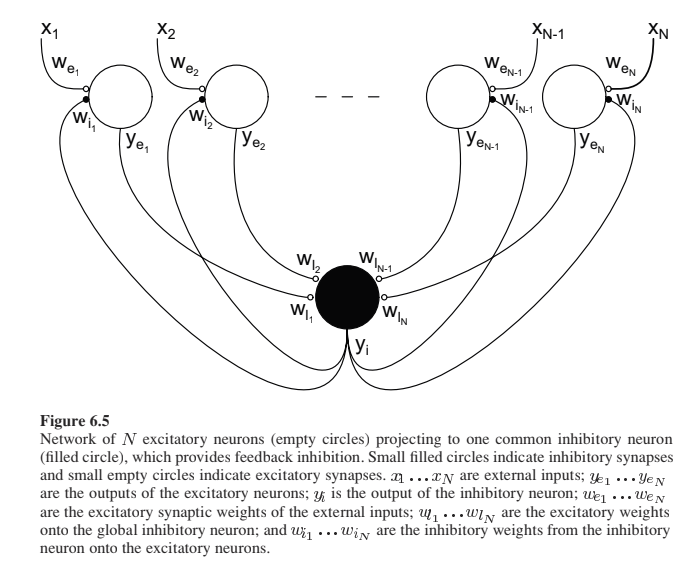
The transfer function of the inhibitory neuron is:

Of course all units may have or not a linear threshold and this complicates things.
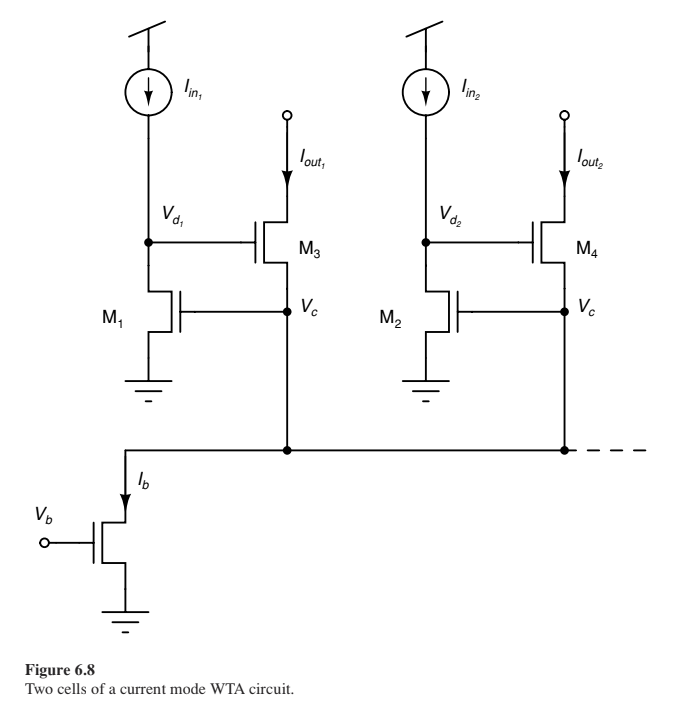
Current mode WTA circuit
Facts
current mode means that the voltages "adapt to the current that is flowing"
- continuous time analog circuit
- parralel processing of the inputs
- each cell is infact a current conveyer
- Can be extended to $n$ cells by connecting others to the $Vc$ node
- Input currents are applied using subthreshold pFETs
- output: all the $I_{outs}$ and all the $Vd$.
Explanation:
- Transistors M1 and M2 discharge nodes $V_{d}$ and implement inhibitory feedback.
- M3 and M4 charge $Vc$ and implement excitatory feedforward.
- The circuit selects the largest input current $Iin$ because the cell in question provides $I_{out} \approx I_{b}$ and suppresses all other output voltages and currents. Also it its $Vd$ determines $Vc$
Conditions
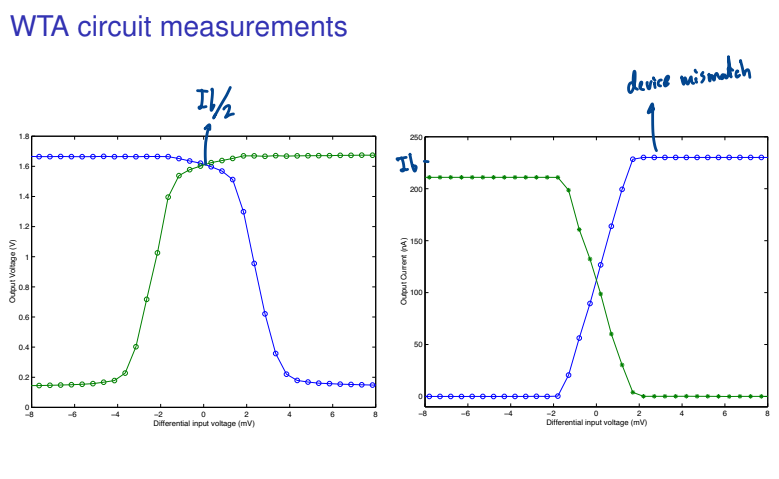
$I_{in_{1}} = I_{in_{2}}=I_{in}$
This means the current flowing through both transistors is equal (because m1 and m2 are both tied to $Vc$) and so their drain voltage smust take the same value. So output transistors M3 and M4 will have the same $Vgs$. ($=V_{d}-V_{c}$).
For n cells: each $Iout=\frac{I_{b}}{n}$$I_{in_{1}}\gg I_{in_{2}}$
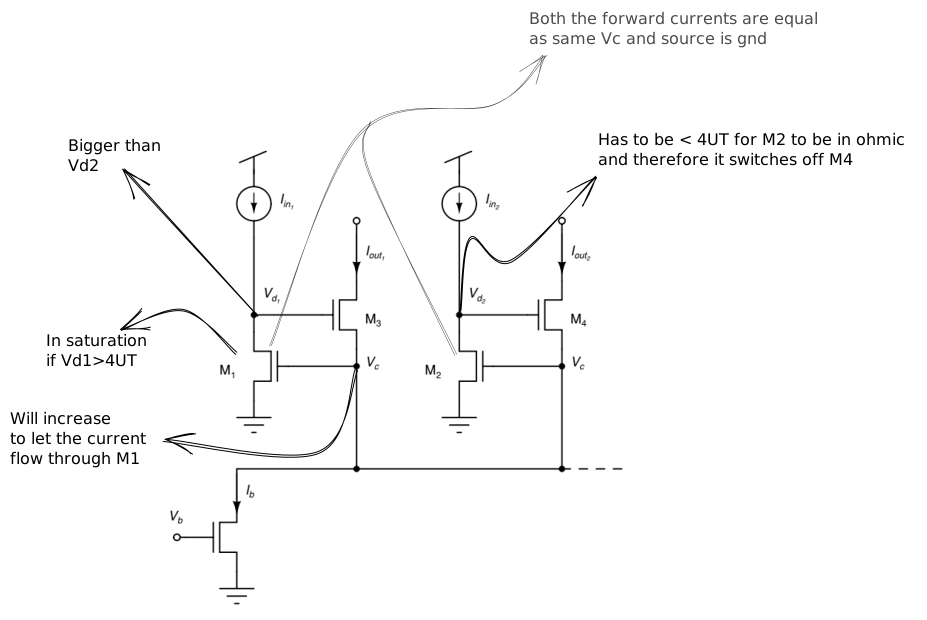
%%🖋 Edit in Excalidraw, and the dark exported image%%
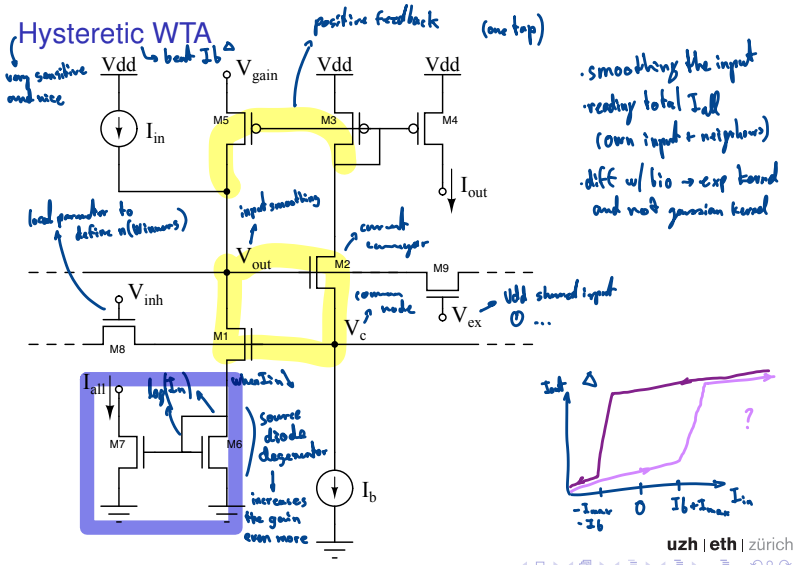
Hysterethetic