Diode connected FET
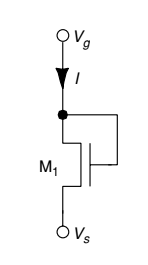
A MOSFET operating in saturation in the subthreshold region, as describedby Eq. 5.1.1 for an nFET, has a drain current that is an exponential functionof $Vs$ and of $Vg$. In this configuration, the MOSFET acts as an exponentia voltage-to-current converter if one of the two voltages is fixed and the othernode is the input. Above threshold, there is a quadratic voltage-to-current con-version as described by Eq. 3.2.39. The inverse function (a current-to-voltage conversion) is obtained by simply making the input signal and or the output signal. The MOSFET acts as a logarithmic current-to-voltage converter below threshold, and a square-root current-to-voltage converter above threshold. The current-to-voltage conversion function in subthreshold can be derived by solving for the output voltage in Eq. 5.1.1:
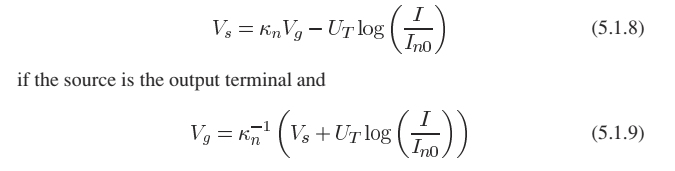
if the gate is the output terminal. In the latter case, we should remember that $Vg$ is determined by the gate charge, which cannot be directly influenced by the input current due to the infinite impedance between channel and gate. In order to make the circuit work, the input node and the gate have to be in a negative feedback loop that controls the gate charge and keeps the MOSFET in saturation.
When the input current is fed into the drain, the feedback from gate to drain is negative, therefore feedback from drain to gate must be positive.
The gate can simply be shorted to the drain to complete the negative feedback loop. The MOSFET is then reduced to a
two-terminal device with similar characteristics to a diode, and is said to be
diode-connected. Since the drain of the diode is always reverse-biased with respect to the channel, a diode-connected MOSFET is always in saturation as long as any appreciable current flows.