The Neural Code
Overview
In the brain there is a lot of encoding/ decoding happening between the different brain areas before behavior is generated
The problem of neural coding is to elucidate “the representation and transformation of information in the nervous system”.
The coding metaphor
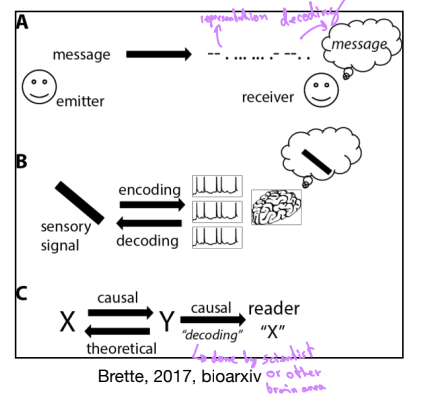
Considering three elements:
Correspondance: The technical sense of a code is a ==correspondance between two domains== (fex: visual signals and spike trains). We call this relation a code to mean that spike trains specify the visual signals, as in a cipher: one can theoretically reconstruct the original message (visual signals) from the encoded message (spike trains) with some accuracy, a process called decoding
Representation: Not all cases of correlations in nature are considered instances of coding. (ex: does rain encode atmospheric pressure? probably not)
Causality: We would not say that visual signals encoderetinal spike trains, even though this would comply with the technical sense. This is because the communication metaphor implicitly assumes a causal relation between the original message and the encoded message. Her spike trains result from visual signals by a causal process (transduction)
Encoding
How does a stimulus cause a pattern of responses?
We build a approximate mechanistic model of the world (We learn to represent all the stimuli out there internally in a matter that is useful for us)
$$
P(\mathrm{Response}|\text{stimulus})\to \text{Encoding}
$$
Decoding
What do the responses tell us about the stimulus?
How can we reconstruct the stimulus
$$
P(\mathrm{stimulus}|\text{Response})\to \text{Encoding}
$$
Finding the stimulus-response realtion
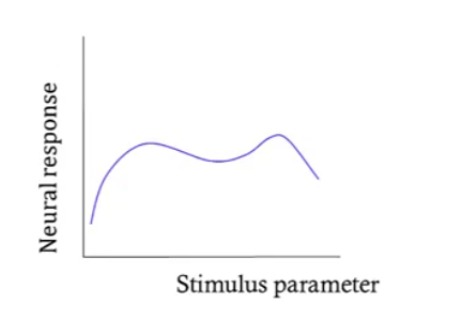
- Encoding motor output in primates
- Recording Neuronal Responses in Cat VI
- Edge Filters in Primate Visual Cortex
- Encoding complex Stimuli in Primate V4
- Encoding Visual Stimuli in the Human Brain (area MTL)
- Encoding Spatial Information in Rat Hippocampus.
Representation and transmission of information
The Paramecium is a “Swimming neuron”. It has the task to follow a certain concentration gradient. It has ciliae on the outside (they move constantly, uncoordinated). It has a mechanism how it encodes this concentration gradient, so that it triggers a spike on the membrane => depending on where it spikes on the membrane, it synchronizes the ciliae on the membrane in a different way so that it moves towards the concentration gradient.
Temporal and rate coding
Rate
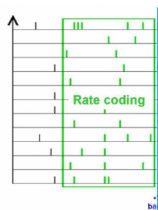
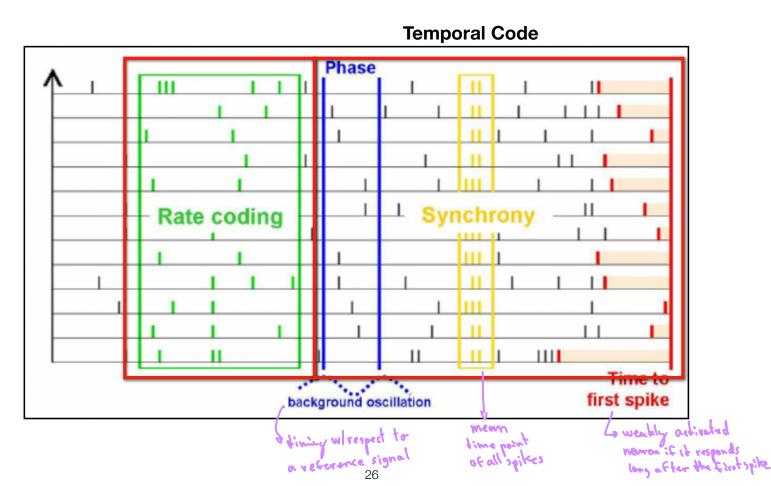
Rate coding: refers to information being carried by the firing rate. (important for plasticity)
Temporal
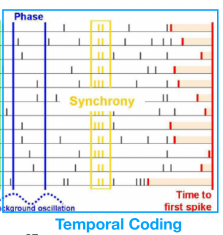
Different ideas:
- (i) much of the information may be transmitted by a neuron during certain small intervals of time
- (ii) synchronous, or quasi-synchronous, firing of neurons within and across ensembles may carry important information
- (iii) the precise timing, or pattern, or spikes may carry information
Phase coding: For every spike you can look where does it spike in the phase of the oscillation
Synchrony coding: How much are spikes synchronized
Time to first spike coding: How much time does it take for the first spike to fire after the stimulus
Temporal vs rate
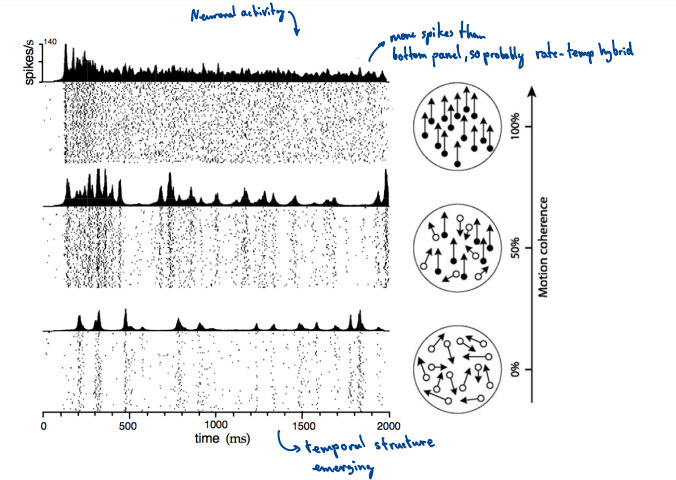
Rate coding example:
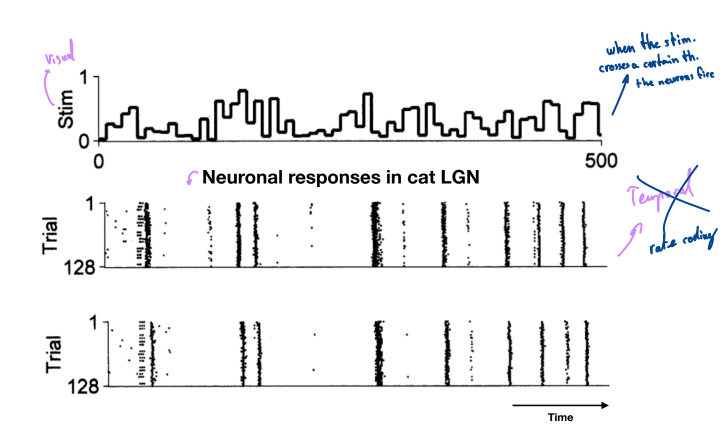
Temporal rate hybrid example: