How to investigate the Stimulus Encoding of a Neuron
Overview
We want to know: How is the stimulus s(t) transformed into the neuron firing rate r(t)? Then we know how the information is encoded.
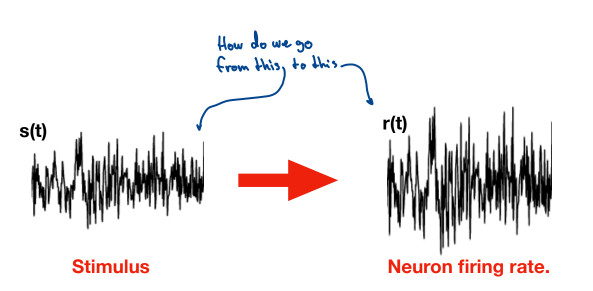
We can attempt this f.e. by measuring the cat visual cortex in vivo while showing stimuli. But there are many factors that influence how the neuron fires beside the stimulus:
Main factors
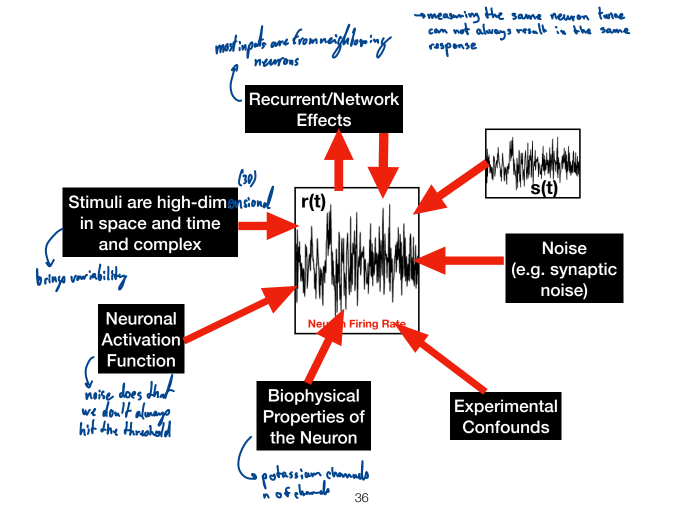
Factors that influence the Neuron firing rate:
- Stimulus s(t)
- Noise (e.g. synaptic noise)
- Experimental Confounds
- Biophysical Properties of the neuron
- Neuronal Activation function
- Stimuli are high-dimensional in space and time and complex (we don’t know where exactly the cat looks)
- Recurrent/ Network Effects (brain is in a different state when already seen the stimulus)
Relations
The simplest relation between $r(t)$ and $s(t)$ is:
$$
r(t) = f(s(t)) \space \space \space[f(s(t-\tau))]
$$
$f$ can be any type of function
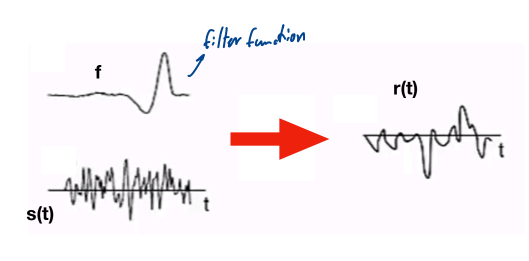
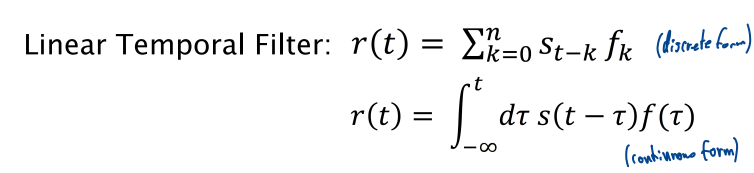
The neuron as temporal filter
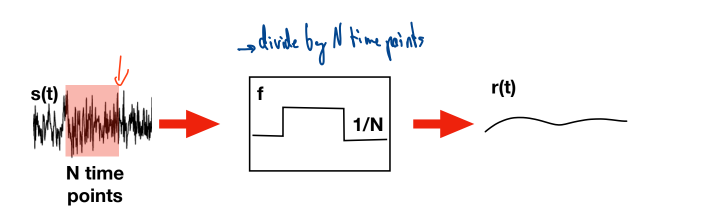
Running avg filter
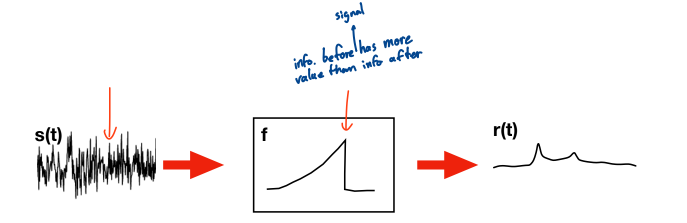
Leaky AVG filter
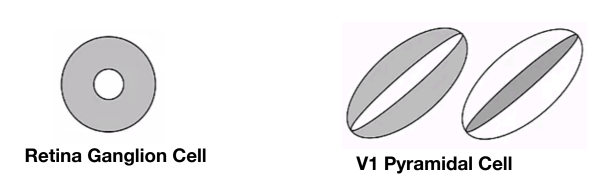
Linear spatial filtering
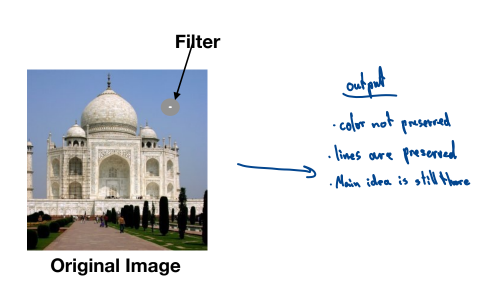
Retina Ganglion Cells respond to a filter. If a stimulus has exactly that profile (innen hell& aussen dunkel), the neuron fires at its maximal intensity. For every pixel we take the value of the pixel and multiply it with the value of the filter (i.e. ganglion cell: everywhere zero, except in middle very high and in circle around very negative)
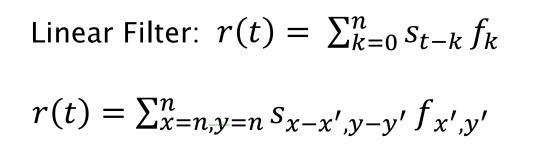
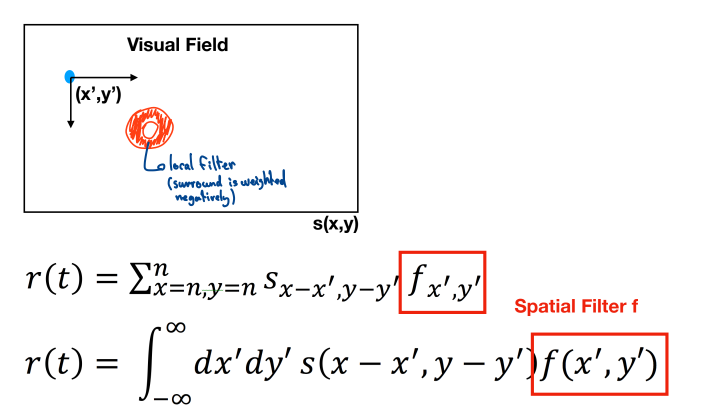
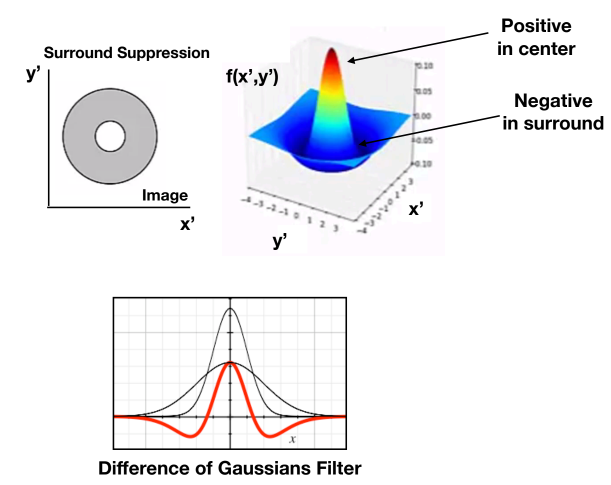
Example
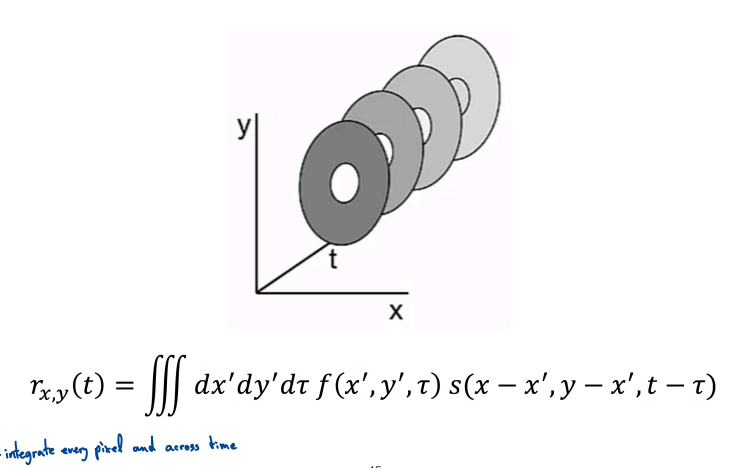
Combining space and time
You integrate over space and time => in brain there are both
Non linear spatial filtering
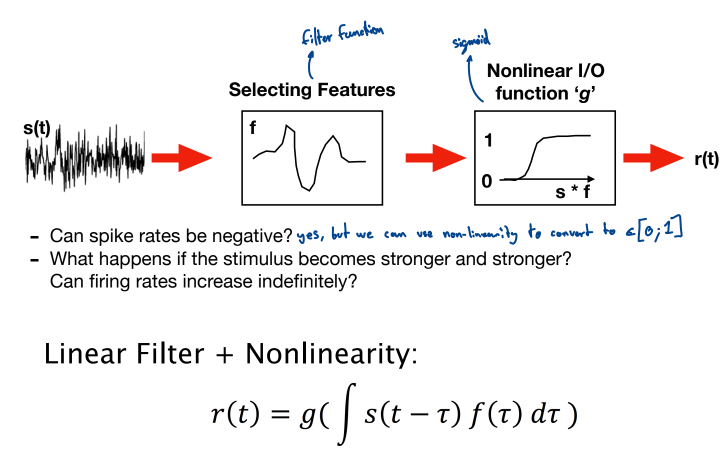
$g()$ is non linear, $s()$ is temporal filter, $f()$ is spatial filter
Quiz
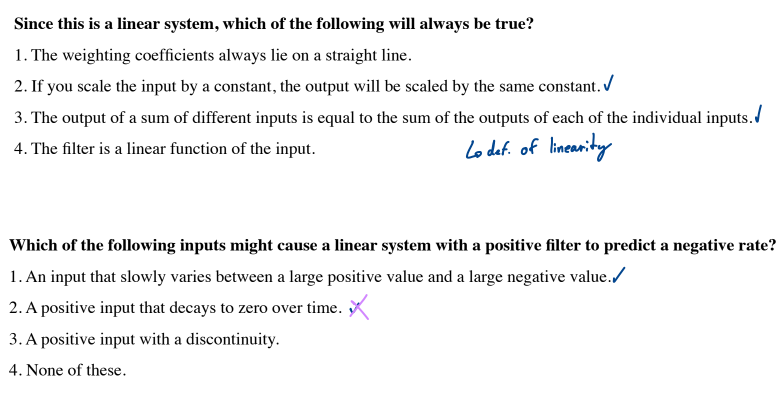
Taking into account spatio-temporal filters
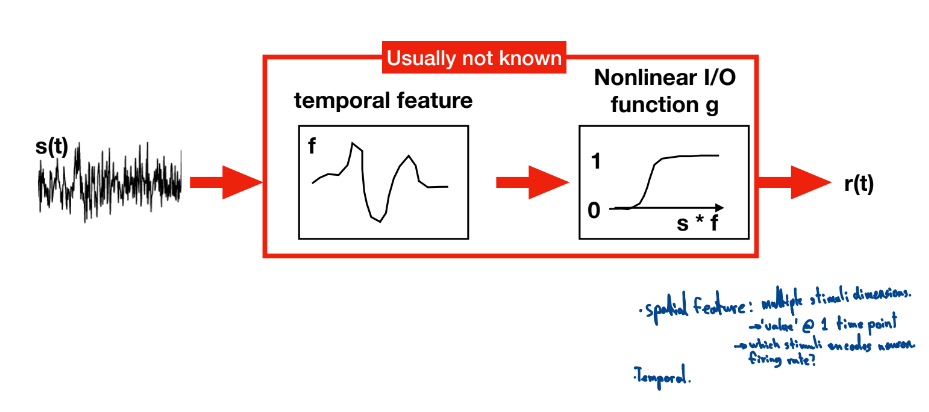
Data is being compressed from High-Dimensional Representation to Neuronal Firing “Low
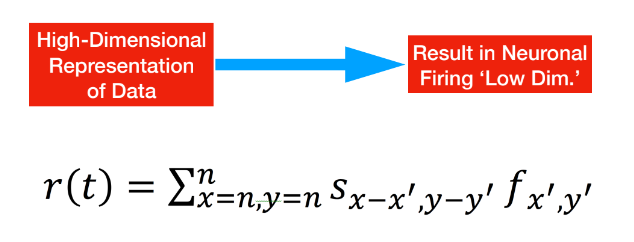
Dimensionality” => Understanding this process how the data is compressed into these neural networks is key
There are two ways of thinking about it:
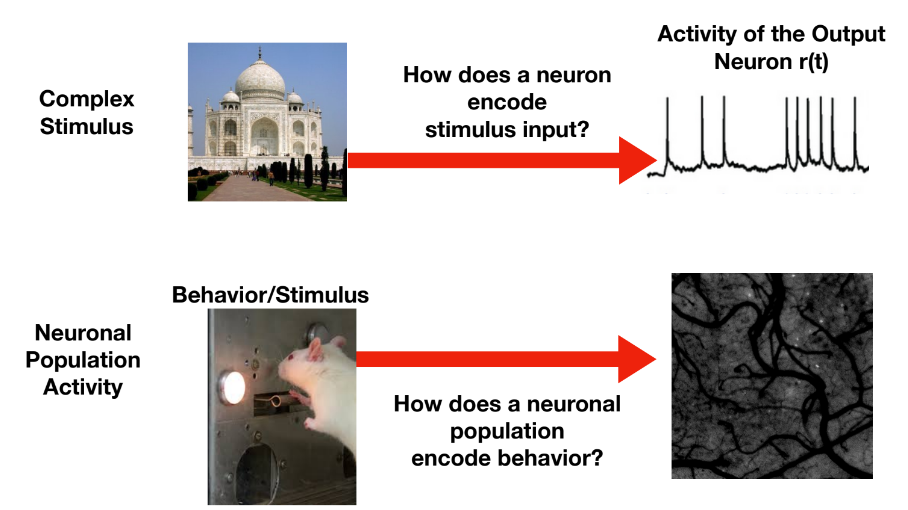
At the neuronal level or at the population level.
- population coding : information available from ensemble that goes beyond simple summation of individual signals
- Measuring Population Activity in vivo
- Finding the max neuronal response (PCALDA)