Chemical synapses
The predominant means of communication between synapses
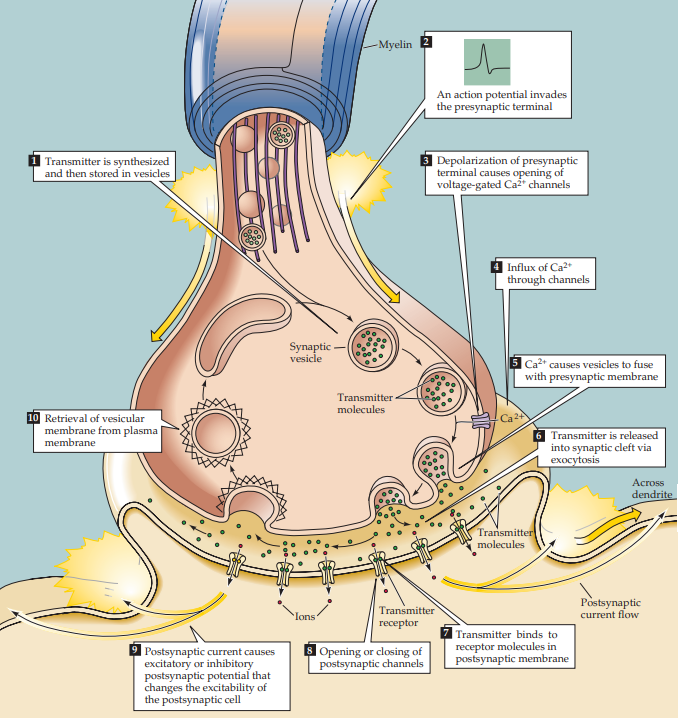
$Ca^{2+}$ causes vesicles to fuse with presynaptic membrane.
Note: Cocaïne affects dopamine reuptake, making it stay longer in synaptic the cleft.
Definition:
Communication between cells which involves the rapid release and diffusion of a substance to another cell where it binds to a receptor (at a localized site) resulting in a change in the postsynaptic cells properties.
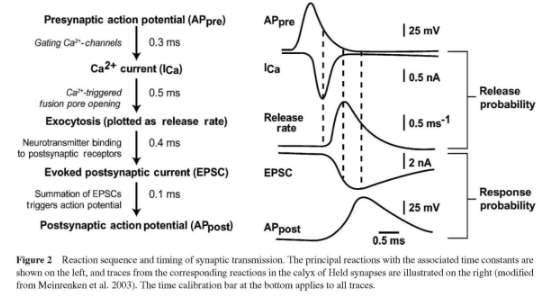
- Contrary to electrical transmission multiple steps are required to release transmitter chemicals and for them to act on postsynaptic receptors, resulting in a time delay (can be as short as 0.2 msec, from Ca2+ entry to secretion, but usually longer because of other factors).
- Directional, select localization of release machinery to presynaptic terminals and receptors to postsynaptic specializations.
- Can change sign by release of inhibitory transmitter.
- Highly modulatable as it has many steps presynaptic terminal and at the postsynaptic sites.(f.e. GABA has different functions over a lifetime)
Steps
- Bring the presynaptic neuron to threshold at axon hillock
- Conduction of AP down the axon ($R*C$ and length dependant)
- Opening of voltage gated $Ca^{2+}$ channels
- Diffusion and action of $Ca^{2+}$ at release machinery
- Exocytosis and diffusion of transmitter in the cleft
- Activation of postsynaptic receptors