Potentiation
Post tetanic potentiation and Long Term Potentiation
Tetanic stimulation leads to post tetanic potentiation (PTP) and later on to long term potentiation. Long term Potentiation is a long-lasting effect where the amplitude of SPSP and the rising slope has increased (> Baseline)
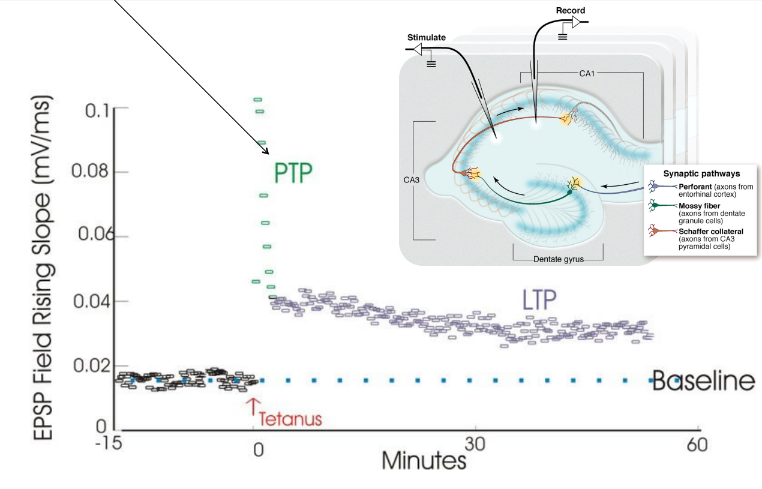
PTP is believed to be caused by a large accumulation of Ca2+ in the terminal caused by a high frequency tetanic stimulation.
Recording of LTP/LTD in HC
LTP
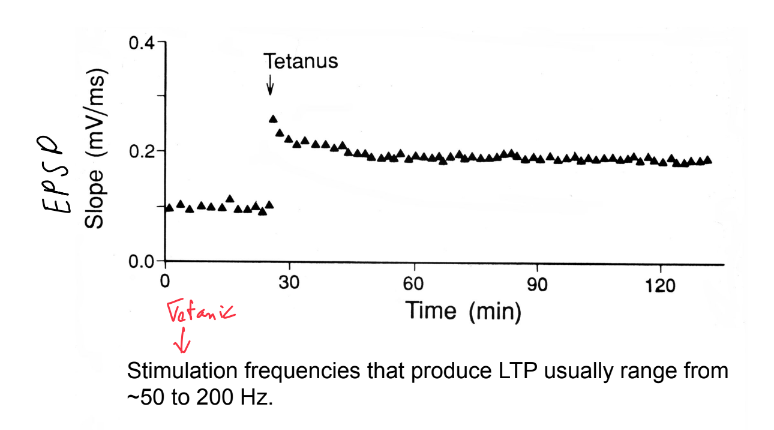
- When stimulated with high frequencies from 500-200 Hz => LTP
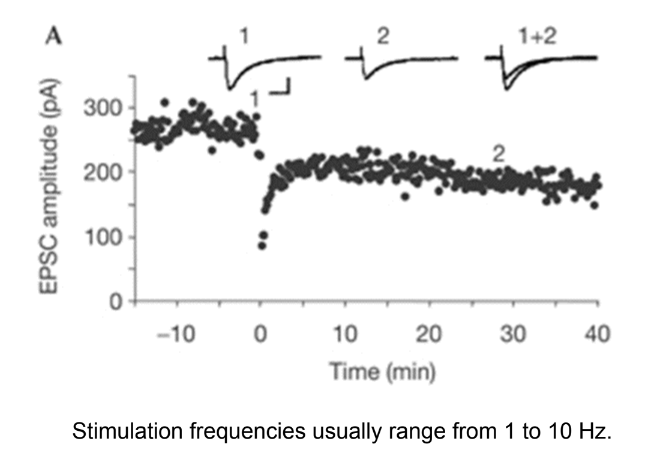
- When stimulated with low frequencies from 1- 10 Hz => LTD
=> dependent on stimulation frequency!
LTD
LTP
- LTP after tetanic stimulation depends on high frequencies
- LTP involves multiple mechanisms across time which all induce long term synaptic strengthening
- LTP mechanisms that last from 30 min to several hours but do not involve protein synthesis
- LTP mechanisms that last longer than a few hours require protein synthesis
LTD
- NMDA receptors are required for LTD
- LTD after tetanic stimulation is dependant on low frequencies
- Involves sevral mechanisms leading to induction of synaptic depression
- LTD and LTP act in concert to change information coding and to implement new memories in the brain.
- STDP is thought to arise from the same mechanisms governing LTP and LTD.
Role of caclium in LTP/LTD
- Calcium flows through the activated receptor
- It targets the calcium/calmodulin regulated protein kinase (CamKs)
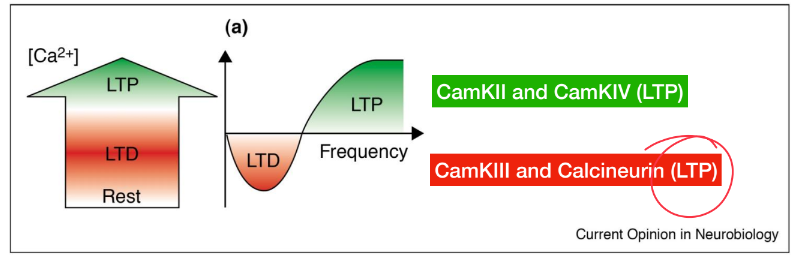
- Level and timing of $Ca^{2+}$ determine LTD or LTP
- Low frequency synaptic firing (~5 Hz) produces LTD;
high frequency synaptic firing (~50 to 100 Hz) produces LTP.
Molecular signalling in the PSD (post synaptic density)
CamKIII and calcineurin bind to to $Ca^{2+}$ at a certain (low) concentration, and down regulate the formation of AMPA receptors.
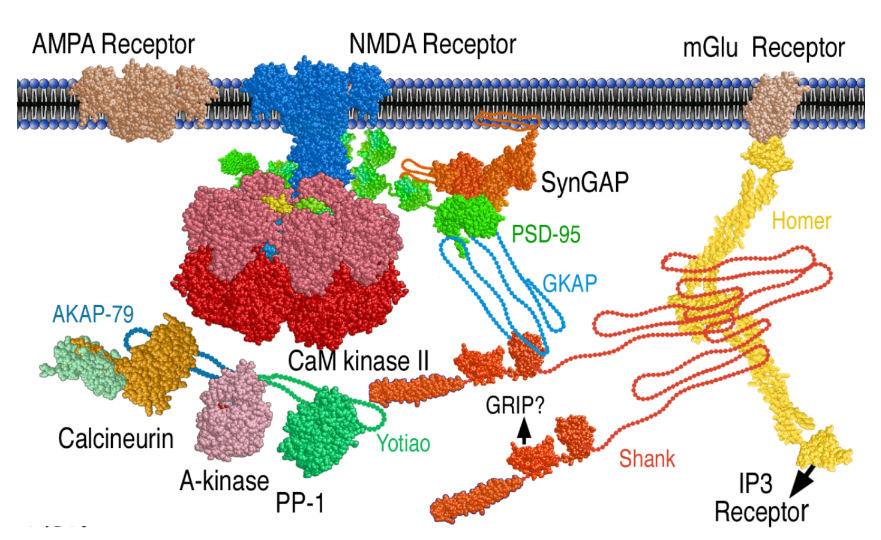
Input synapse specificity of LTP and LTD
A synapse needs to be active so LTP can happen
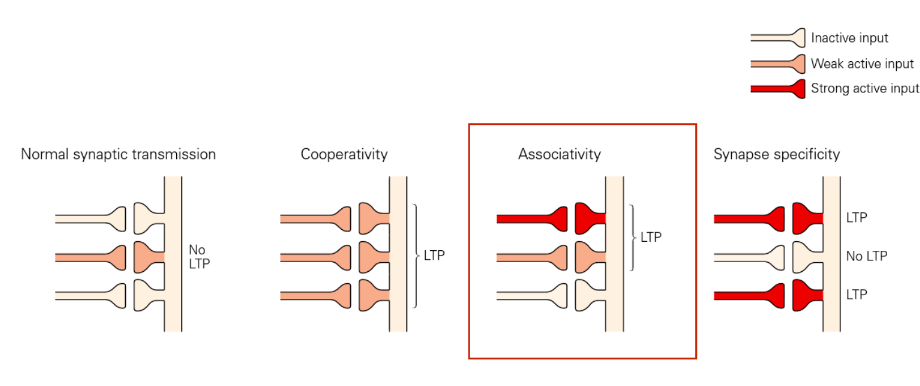
- Cooperativity (induction threshold)
- Input/synapse specificity
- Enables associative learning